
New Administrative Rules for Separation from Service Start Jan. 1, 2027
Applies to TRS members applying for retirement benefits or termination refunds

TRS is updating its administrative rules pertaining to separation from service when a member applies for a TRS retirement benefit or a termination refund. The new rule will take effect Jan. 1, 2027.
Current rule
Under current rules, members are required to stop only TRS-covered employment (e.g., a licensed teaching position). Members may continue working for their last employer in a non-licensed or non-TRS-covered role (such as coaching or bus driving) without impacting their ability to begin a retirement annuity or receive a termination refund.
Jan. 1, 2027 rule
For claims with an effective date of retirement of Jan. 1, 2027, or later, or refunds requested on or after that date, the separation requirements will apply to all employment with the member’s last employer(s), both TRS-covered and non-TRS-coveredemployment.
Members must:
• fully separate from service with their last employer(s), meaning they must terminate employment in all capacities (both TRS-covered and non- TRS-covered),
• not have prearranged re-employment with their last employer(s) prior to their termination date, and
• remain separated from employment with their last employer(s) for a minimum of 30 days after their termination date.
All members who plan to retire after Jan. 1, 2027, must comply with the administrative rule. Members who do not meet separation requirements will not be eligible to begin their retirement annuity or receive a termination refund until the requirements are met.
Legislation Passed During Spring Legislative Session Impacts TRS Members
Buyout programs and post-retirement limits extended, private school interest rate change

Several bills impacting TRS members passed during the spring 2026 legislative session. For more information on these bills, you may visit the Illinois General Assembly website, ilga.gov.
Buyout Programs extension (House Bill 5196)
Extends the expiration date of the Accelerated Annual Increase (AAI) buyout program for Tier 1 members and the Accelerated Pension Benefit (APB) buyout program for inactive members from June 30, 2026, to June 30, 2028. This bill was signed into law by Governor Pritzker on June 16, 2026. TRS notifies all eligible members about the programs.
Post-retirement work limitations extension (Senate Bill 3645)
Extends the law permitting retired TRS members to accept work for 120 days or 600 hours as teachers or administrators in public schools without affecting their pensions until June 30, 2029. This bill is anticipated to be signed into law by Governor Pritzker. The original limits were 100 days and 500 hours. See Chapter 12: Post-retirement Matters in the TRS Member Guide online, trsil.org, for more information.
Private School optional service contributions interest rate change (Senate Bill 4010)
Effective January 1, 2027, changes the interest rate applied to payments made to purchase private school optional service from the actuarially assumed rate of 7% to the regular interest rate (currently 6%). Members must still apply to purchase private school optional service credit on or before June 30, 2028. See Chapter 6: Optional Service Credit in the TRS Member Guide online, trsil.org.
We’re Listening and Making Changes Based on Your Survey Comments
As TRS continuously works towards improving member services, we have identified the following key success indicators for customer service:
- members understand the role of TRS,
- TRS is effective in educating members about why TRS is relevant across all stages of their career,
- TRS proactively engages with its members to understand their needs and preferences,
- members are confident in their knowledge of their benefits and retirement preparedness,
- members enjoy a seamless transition into retirement, and
- members are highly satisfied and trust TRS.
In order to understand whether TRS is being successful in improving our services and understanding member needs and preferences, we implemented a research effort which included expanding the opportunities where members could provide feedback to TRS through surveys.
We now provide opportunities for feedback from our members after each incoming phone call, benefit counseling session, educational webinar and after member benefits are processed, as well as when members use the online member portal, MyTRSIL.
On an annual basis, we also reach out to a random sample of members and retirees to solicit feedback.
As a result of this research effort, we wanted to inform you of the progress being made towards a few of the key success indicators and assure you that your voice is being heard!
Members understand the Role of TRS
TRS provides expert pension services to Illinois public educators, ensuring their promised retirement security. In our annual surveys, we asked members what they believe is the primary function of TRS. Based on the responses we received, we determined more clarity around the role of TRS was needed.
We now capture the Role of TRS in every Topics & Report newsletter as well as educational presentations we conduct to promote clarity. It’s important to note that TRS does not have the authority to write or pass legislation. Such decisions rest with the Illinois General Assembly.
Educating members about why TRS is relevant across all career stages
Surveys indicated newer members feel less confident in their knowledge of TRS benefits and how to prepare for retirement now. To fill this need, a webinar for newer members was created “Understanding the Value of your TRS Benefit." The webinar explains TRS benefits and how saving early in a plan such as the optional TRS Supplemental Savings Plan (SSP) may result in a better financial future at retirement.
The top two responses from late career stage members and retirees about what they wished they would have known earlier in their TRS career was:
- engaging with TRS early in their career and
- investing in a supplemental plan early (TRS SSP, IRA, 403(b), etc.).
TRS also created a new webinar series “Connecting with Retirees” which is a series of webinars about topics such as transitioning to Medicare, TRS death benefits or setting up a power of attorney on your TRS account.
We have made it easier to engage with educational representatives in our Outreach Department to learn about TRS benefits in all stages of your career through our new Webinar Calendar. Checkout upcoming live webinars and register at your own convenience at trsil.org/calendar. Bookmark the calendar page and check back often for new additions.
Members enjoy seamless transition into retirement
In response to surveys sent to recent retirees, we have a new way to serve members who have started the retirement process! As part of our mission of delivering expert pension service, a new tracking feature has been enabled in MyTRSIL member accounts to allow for retirement process transparency. Members can now track how close they are to receiving their first retirement payment.
Members can log in to their MyTRSIL member account, trsil.org/MyTRSIL, to track the status of their retirement claim in real time. The tabs will turn from red to green when complete.

Once you are retired, we have made it easier to find your monthly benefit details by adding it directly to the landing page in your MyTRSIL member account, including the amount and date of your next COLA increase. If you need a printout of your benefit payments, access them at MyTRS pay stubs within your MyTRSIL member account.
As TRS pursues our Vision to be the trusted retirement resource for generations of our members, take time to complete a TRS survey when given the opportunity so your perspective may be heard!
Annuitants Must Follow Post-retirement Employment Limitations

Don’t lose your retirement benefit!
Retired TRS members may work 120 days or 600 hours in a TRS-covered position per school year. Legislation to extend the 120 days/600 hours limit through June 30, 2029, is anticipated to be signed into law by Governor Pritzker.
Exceeding the limitations
If an annuitant exceeds post-retirement employment limitations, some of the consequences are:
- retirement annuity will be terminated,
- annuitant will re-enter active membership,
- the employer must remit TRS contributions on all creditable earnings after the employment limitations are exceeded, and the annuitant’s TRS retiree health insurance may be impacted.
Limitations in first year of retirement
There are two circumstances where an annuitant will be required to repay all annuity payments in full from the date of retirement:
- if the annuitant resumes teaching in the same school year in which they retired or
- if the annuitant exceeds the employment limitations in the first school year following retirement.
If an annuitant does either of these, they will no longer be retired. The annuitant will become an active member who contributes to TRS.
Track days and hours worked
An annuitant who works in a TRS-covered position must keep track of the hours worked to avoid exceeding the limits and having the significant consequences noted earlier imposed. Since the beginning of 2025, a notification has been sent from TRS to the retiree explaining the limits when a retiree begins post-retirement work. TRS will send a second notification when the retiree has worked 450 post-retirement hours (as reported by the employer) and the retiree is close to exceeding the limits.
The responsibility rests with annuitants to keep track of their days and hours worked because these statutory limits are mandated by law. Retirees are encouraged to use the Post-Retirement Days Worked Report form: trsil.org/post_retirement_days_worked.
TRAIL MAPD Program Information for Medicare Eligible Members
The State of Illinois requires all Medicare eligible retirees, annuitants, survivors and covered dependents who are currently enrolled in the Teachers’ Retirement Insurance Program (TRIP) to transition into the Total Retiree Advantage Illinois (TRAIL) Medicare Advantage Prescription Drug (MAPD) Program effective the date the plan participant becomes eligible to enroll in Medicare parts A and B (based on age or disability).
The TRAIL MAPD Program is a subset of TRIP that provides Medicare-eligible members and their covered Medicare-eligible dependents comprehensive coverage. A TRAIL MAPD plan is a Medicare-approved plan that combines the different parts of Medicare into one plan. This program also provides plan participants with separate dental and vision coverage at no additional cost.
Since the TRAIL MAPD plan is a type of Medicare, members must continue to pay federal Medicare premiums to the Social Security Administration even after enrolling into a TRAIL MAPD Plan.
For members who are newly-eligible for Medicare and not currently enrolled in TRIP, you have three opportunities to enroll into the TRAIL MAPD plan:
- Initial Enrollment (IE): Members can enroll within six months of the 65th birthday. Initial enrollment is a one-time offering. For more details, read the Medicare Checklist at trsil.org/Medicare-Checklist online.
- Annual Enrollment (AE): Members can enroll within a 30-day window each fall from mid-October through mid-November.
- Loss of other insurance coverage.
Annual Enrollment Period Information for the TRAIL Medicare Advantage Program
The TRAIL MAPD Open Enrollment Period for the 2027 plan year will be held this fall from mid-October through mid-November. The upcoming TRAIL MAPD plan year will run from Jan. 1, 2027, through Dec. 31, 2027.
Most TRIP plan participants who are eligible for Medicare Parts A and B are required to enroll in the TRAIL MAPD plan in order to keep TRIP insurance coverage. This fall, Central Management Services (CMS) will send information about the program including any upcoming changes for the new plan year.
Visit the Total Retiree Advantage Illinois (TRAIL) Program page on the MyBenefits website at MyBenefits.illinois.gov for more information.
Important address requirements for TRAIL members or newly-eligible TRAIL members
Your address on record with TRS must match the address on record with the Social Security Administration (SSA).
To change your address with TRS:
- Update your address online in your TRS MyTRSIL member account. Visit trsil.org, select the Member Login button and log in
or
- Download it at trsil.org/change-of-address-form or call TRS at (877) 927-5877 for a Change of Address Form.
You must update your address with both TRS and the SSA. SSA will provide your updated address to federal Medicare as well as the TRAIL MAPD plan administrator.
To change your address with SSA:
- Update your address online through the SSA website at ssa.gov/life-events/update-contact-information
or
- Contact the SSA and update your address by calling 800-772-1213.
Annual Fall Benefit Information Meetings Explain Retirement & Benefits
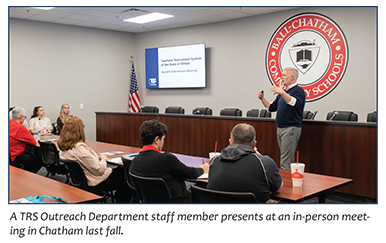
Will be held in person and virtually
TRS will host in-person and virtual meetings for members from September to November that are designed to explain the retirement process and to provide members with information about disability, death and insurance benefits. The sessions are planned for members who are not retired.
The presentations will have information for both Tier 1 and Tier 2 members. As a reminder, Tier 1 members first contributed to TRS or a reciprocal retirement system before Jan. 1, 2011 and Tier 2 members first contributed to TRS or a reciprocal retirement system on or after Jan. 1, 2011.
Visit trsil.org/Fall_Member_Meetings in late August for the 2026 schedule. In late August, the virtual schedule and in-person meeting locations will be available on our website and an email alert will be sent to active members with both meeting schedules. Registration is required to attend a virtual meeting. No registration is necessary for in-person meetings.
Wait Four Months to Receive a Refund of Retirement Contributions

Now that the 2025-26 school year is over, some teachers may not be returning to the classroom.
A member must terminate employment with their current employer(s) and stop work in all capacities for at least 30 days, both TRS-covered and non-TRS-covered (non-TRS-covered rule is effective Jan. 1, 2027; e.g., bus driver or coach) before they may apply for a refund of retirement contributions.
The law imposes a four-month waiting period. A refund cannot be processed until four months have passed since the member’s final day of teaching.
A refund of retirement contributions, which consists of the portions used to pay the retirement annuity (7.5%) and the annual increases in the annuity (0.5%), should be carefully considered because it terminates the member’s benefits and will be costly to repay if the individual returns to teaching in the future.
Contributions of 0.4% for the expired Early Retirement Option will also be refunded if a member has not already applied and received that refund. If the member receives a refund of retirement contributions, the individual is not entitled to any other refunds. The contribution for the Teachers’ Retirement Insurance Program and the 1% survivor benefit contribution are not refundable.
After the member contacts TRS about the refund, TRS will send the application by regular mail.
The application can be returned any time after the member has formally terminated from both TRS-covered and non-TRS-covered employment and 30 days have passed.
Once a properly completed refund application and any required supplementary earnings information from the school district(s) are received, we will process the refund and forward it to the Office of the Comptroller for payment when four months have passed following the member’s final day of teaching.
TRS Supplemental Savings Plan Surpasses $100 Million

The TRS Supplemental Savings Plan (SSP) has reached a remarkable milestone, surpassing $100 million in total assets and over 14,000 participants in less than five years since its launch in 2022. This rapid growth reflects the strong commitment of teachers, administrators and school employees across the State of Illinois to take charge of their financial futures.
As the plan sponsor, TRS operates the SSP solely in the best interest of its members. The 457(b) retirement savings plan is intentionally structured to be a high quality, low cost savings option that supports educators throughout their careers.
One of its defining strengths is portability: the SSP can follow a TRS member across multiple TRS covered employers, ensuring continuity and stability even as educators move between districts or advance into new roles.
While the TRS pension remains a cornerstone of retirement security, the Supplemental Savings Plan helps educators:
- Keep pace with rising costs of living
- Prepare for future financial needs, including potential healthcare expenses
- Build financial flexibility and independence
- Strengthen long-term financial resilience
Looking Ahead
With assets surpassing $100 million and participation continuing to rise, TRS anticipates even stronger growth in the years ahead. Increased financial education efforts, district outreach and partnership, and broader awareness of the importance of supplemental savings are expected to drive continued momentum.
The SSP’s success shows that when educators have access to a trusted, well-designed savings plan, they can build the retirement they deserve.
How to Enroll
Active TRS members who are full-time or part-time contractual employee can learn more about contributing by visiting trsilssp.voya.com or calling the TRS SSP Service Center at 844-877-4572 (844-TRS-457B).
Role of TRS
TRS provides expert pension services to Illinois public educators, ensuring their promised retirement security. Governed by a 15-member Board of Trustees, TRS operates as a fiduciary, managing benefits and assets responsibly, in compliance with the law and in the best interests of our members.
TRS does not have the authority to write or pass legislation. Such decisions rest with the Illinois General Assembly. TRS serves as a reliable resource to legislators and stakeholders, providing subject matter expertise on pension-related matters.
For legislative concerns, members should contact their state representatives. TRS is committed to delivering exceptional service and support to all members.
Summer 2026 | Published by the Teachers' Retirement System of the State of Illinois